
 +91 6201533997
 Blogs

What Is GEO (Generative Engine Optimization) and Why Your Business Needs It in 2026
Everyone is saying AI is killing search. But has anyone stopped to think - if people stop searching, who loses the most? Google does. And Google is not going to let that happen quietly.
Search is not dying. It is updating. Just like your phone gets a software update and suddenly everything works differently, search got its own update. And that update has a name.
It is called Generative Engine Optimization.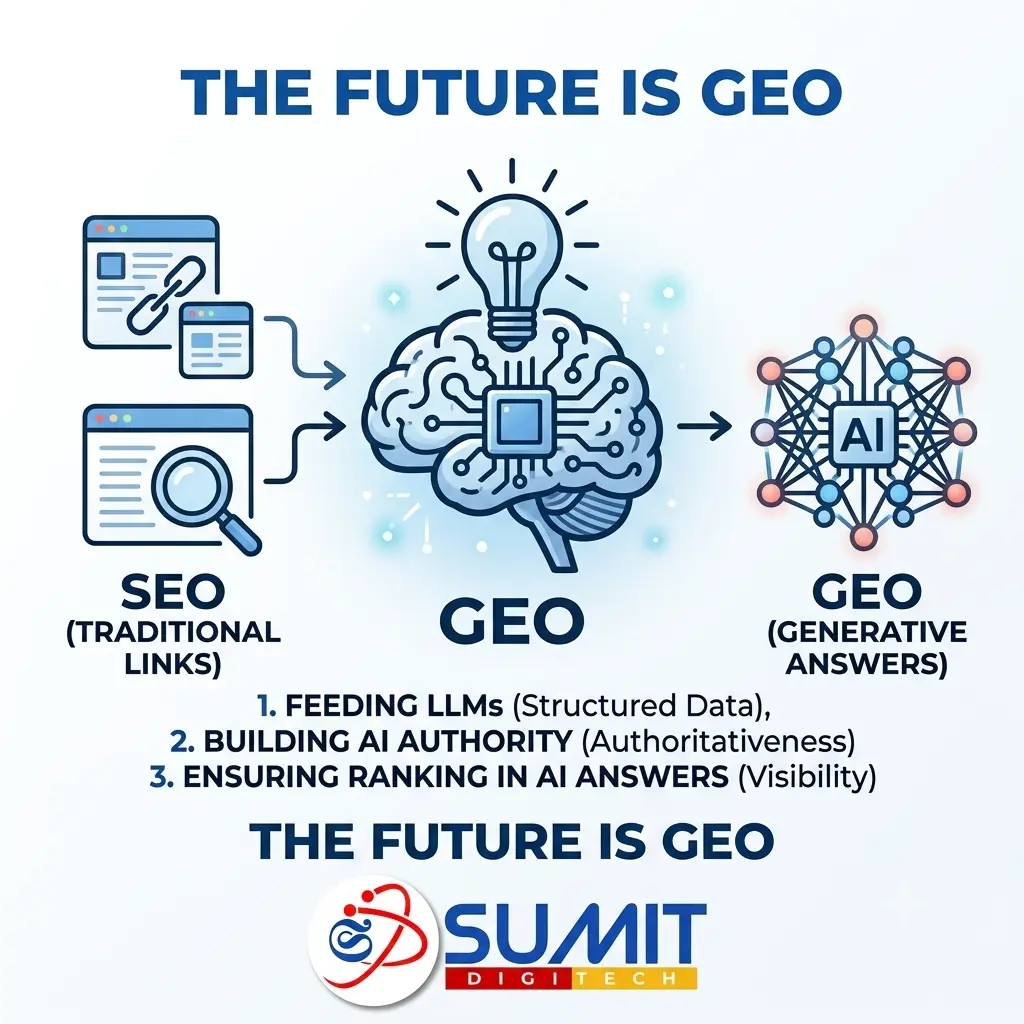
What Is Generative Engine Optimization - And Why Should You Care?
Generative Engine Optimization is the process of getting your content cited inside AI-generated answers.
Not ranked. Not linked. Cited - like a source. When someone opens ChatGPT and asks "Which digital marketing agency is good for SEO in India?" - the AI pulls from websites it trusts and shows them as references. Generative Engine Optimization is what gets your website into that list.
Traditional SEO got you on Google's first page. Generative Engine Optimization gets you inside the answer itself. Both matter now. Neither replaces the other.
Why Is Everyone Suddenly Talking About Generative Engine Optimization?
Because the numbers are impossible to ignore.
Around 40 to 50 percent of informational searches in 2026 now show AI-generated answers before anything else. ChatGPT crossed 100 million daily active users. Perplexity is growing every month. Google Gemini is sitting right inside Google Search now - so even people who go to Google are getting AI answers first.
Think about it this way.
Your website ranks number one on Google. Someone searches your keyword. But instead of clicking your link, they read the AI answer at the top and leave. You got the ranking but lost the user.
That is the gap Generative Engine Optimization fills.
And here is the part most people miss - the brands showing up in AI answers right now are not always the biggest ones. They are the ones with well-structured, credible content. Which means you do not need a massive budget to compete. You need a smarter approach.
How Is Generative Engine Optimization Different from SEO and AEO?
Three terms, three different jobs. Worth knowing the difference.
Traditional SEO gets your pages ranking on Google. Backlinks, domain authority, on-page optimization - all of that goes into getting a higher position in search results.
AEO - Answer Engine Optimization - is about getting your content into Google's own answer features. Featured snippets, People Also Ask boxes, AI Overviews inside Google Search. Still Google-focused, but built around direct answer extraction.
Generative Engine Optimization goes beyond Google. It targets the AI tools people use instead of Google ChatGPT, Perplexity, Claude, and Meta AI. These tools do not just index your page. They read it, understand it, and decide whether it is credible enough to reference in an answer.
All three work together. Skip any one of them, and you have a visibility gap somewhere in 2026.
What Does an AI Tool Actually Look for Before Citing Your Content?
Think about it - why would any AI cite your website? It will only cite the ones it trusts. That is really it.
And that trust builds when your content has these things:
- A real author name - not just any name, but with an actual designation and background. If there is no name on the article, AI assumes some content farm wrote it. Those sites get skipped
- Original numbers and data - if you just copy what others already said, AI will ignore it. Run a small survey, show your client results, put any original figure in there - AI cites the content where something new exists
- Answer first, explanation later - AI has no time to read through three paragraphs looking for your point. Say what you need to say in the first two lines. Write everything else as support
- Mention real things - actual tool names, actual companies, actual statistics. Lines like "many experts believe" do nothing. AI needs context, and context only comes when you get specific
- Other websites should mention you - this is GEO's version of a backlink. When credible publishers reference your name, it proves to AI that real people in the real world found your content useful
- Write more on one topic - do not write one article and forget about it. The more interconnected articles you have on the same subject, the more AI treats you as an authority on it
One line to remember - AI cites whoever it trusts and whoever is clear. That is the whole game.
How Do You Actually Start With Generative Engine Optimization?
Start with what you already have. Fix it. Then build forward.
First thing - put a real author on every article. Name, designation, two-line bio, link to LinkedIn. That one change alone improves how AI systems read your content.
Second - add original numbers wherever possible. A client result. An internal finding. A small survey you ran. Original data gets cited. Generic summaries do not.
Third - rewrite your section headings as questions. AI models are trained on question and answer patterns. Headings like "What is Generative Engine Optimization" work better than headings like "Introduction to GEO."
Fourth - lead every section with the answer. Stop making the reader hunt for your point. State it immediately. Then go deeper.
Fifth - add FAQ schema markup. Structured data makes it easier for AI systems to extract clean answers from your content. The FAQPage schema is one of the fastest wins in Generative Engine Optimization.
Sixth - build content clusters. Pick three to five core topics for your business. Write multiple articles on each. Connect them with internal links. That topical depth is what makes AI systems treat you as an authority rather than a one-time source.
Seventh - get mentioned by other websites. Guest posts, expert quotes, and collaborations with other publishers in your niche. Every external mention is a trust signal for AI tools.
Which Businesses Actually Need Generative Engine Optimization Right Now?
Any business where the customer does research before making a decision.
Service businesses. Digital agencies. Healthcare providers. Finance companies. Education brands. SaaS products. Anyone in a space where people ask questions before spending money.
Because those people are asking AI tools now, and if your brand is not in the answer, a competitor who invested in Generative Engine Optimization probably is.
For businesses with mostly offline, walk-in customers, GEO matters less right now. For everyone competing online in any research-driven category, it is quickly becoming non-negotiable.
We are experts in Generative Engine Optimization along with SEO you already have And through Sumit Digitech, we ensure that your company's name is visible on Google ranking, AI Overviews, and other third-party AI tools, all at once.
SEO did not die. It updated. And Generative Engine Optimization is the newest part of that update.
The brands building GEO authority today are already showing up in AI answers their competitors are missing. That window is still open - but the earlier you move, the bigger the advantage.
Want your content showing up where your audience is actually searching in 2026? Talk to Sumit Digitech.
Follow us on Instagram and Facebook for the latest SEO tips and updates.
Tags
Frequently Asked Questions
It is the work you do that AI tools like ChatGPT and Gemini cite your website in their answers. Your content becomes a trusted source that the AI references.
No. Generative Engine Optimization adds a new layer on top of SEO. Both are needed in 2026 - SEO for Google rankings, GEO for AI citations.
Some well-optimised content gets picked up within weeks. Building consistent authority across your full site usually takes three to six months of focused work.
Not at all. AI tools cite based on content quality and credibility - not company size. Strong, structured content from a small brand competes just as well.
We audit your content for GEO readiness, restructure articles for AI citation, build author authority signals, and create new content built to appear in ChatGPT, Gemini, and Perplexity answers